
Feelings Check-In
EmotionsTap the face that shows how you feel. Then tap what would help. Maggie says everything out loud, and there are no wrong answers. A printable check-in chart is further down the page.








What a feelings check-in is
A feelings check-in is a short, regular moment when a child says how they are feeling. In most homes and classrooms that means pointing at a face on a chart. It takes about thirty seconds, it happens at roughly the same time each day, and nobody is asked to explain themselves.
It is not a behaviour chart, a mood diary or a test. There is no good answer and no bad answer. A child who taps angry every morning for a fortnight has not failed the check-in; they have told you something, which is the whole point.
The board above does the check-in in two taps. First the child picks a face. Then they pick something that might help: a hug, some quiet time, a drink of water, a word with a grown-up, some time to play, or a few slow breaths. The result is shown as two big pictures so the child can hold the screen up to an adult, which for a child who does not speak is the entire conversation.
Why this works better than "are you okay?"
Ask a small child how they are and you get "fine", or a shrug, or nothing. A chart with faces on it turns an impossible open question into an easy closed one: which of these is closest? Recognising a feeling on a face is much easier than generating the word for it, and pointing is easier than saying it.
Putting a feeling into words also tends to take some of the heat out of it. Psychologists call this affect labelling, and it shows up in brain imaging: naming the feeling turns the volume down a little. That is why Maggie repeats the feeling back ("You feel angry. That's okay. Angry is allowed.") rather than moving on. The repetition is the useful bit.
The second step is where the actual skill lives. A feeling on its own is just weather. A feeling plus what would help is the beginning of self-regulation: the child learns that being sad comes with options, and that they get to choose one. Over months, children who practise this start reaching for the options without a board. That is the goal; the board is the scaffolding.
How to run a check-in in thirty seconds
- Same time, every day. After breakfast, on arrival at school, after lunch break. Predictability is half of what makes it safe.
- You go first. "I'm feeling a bit tired today." An adult who models it makes it ordinary rather than a spotlight.
- Accept the answer. Whatever the child taps is correct. Do not say "you don't look sad" and do not talk them into happy. Being believed is what makes them do it again tomorrow.
- Do not ask why. "Why are you angry?" is a hard question and often has no answer. If the child wants to tell you, they will. Use the what would help step instead; it is a question they can answer.
- Act on the help. If they chose a hug, give the hug. If they chose quiet time, find two minutes. A check-in where the help never arrives teaches that the board does nothing.
- Check out later. Once the feeling has passed, a second tap on the board shows the child that feelings change. That lesson is worth more than any single check-in.
The ten feelings, and why there are not thirty
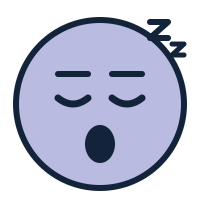
Charts with forty faces look thorough and get used by nobody. Small children reliably tell apart a handful of feelings, and even adults, asked to name what they feel right now, mostly land on the same few. The board uses ten: happy, sad, angry, scared, tired, calm, excited, worried, silly and sick.
The set is deliberate. The first four are the ones nearly every child recognises first. Tired and sick are on the board because for young children those are feelings, and a lot of what looks like bad behaviour is one of them in disguise. Calm gives a child a name for the state you want them to find their way back to. Worried is separate from scared because a child can tell the difference between a spider and a spelling test long before they have the words for it. Silly is there because it is real and because a check-in that only has heavy feelings on it feels like a doctor's appointment.
The feelings setting lets you start with four, then six, then all ten. Start small. A child who has never done this before does better choosing between four faces than scanning ten.
Using it with a child who does not speak
This board was built with nonspeaking and minimally speaking children in mind, which is why every answer is a tap and every tap is spoken back. For a child who cannot say "I'm scared", pointing at the scared face and hearing Maggie say it aloud is a real sentence, produced by them, that a grown-up can respond to.
If the child uses AAC, the board is not a replacement for it. It is a fast, low-effort way in. Many families find the child will tap a face here on a bad day when opening the AAC app feels like too much, and that is fine. Model the same words on their device afterwards if you can.
Two things help. Keep the words switched on unless the child is distracted by them, because the pairing of face, printed word and spoken word is how the vocabulary sticks. And use the same board every time. A familiar set of faces in the same places is far easier to use under stress than a new chart each week.
Using it with an autistic child
Many autistic children find it genuinely hard to tell what they are feeling from the inside, a difficulty with what is called interoception. So "how do you feel?" can be an honest blank. A few adjustments make the board more useful.
- "I don't know" is a valid answer. The nothing right now button on the second step exists for this. Never insist on a feeling.
- Go from body to feeling. "Your hands are squeezed tight. Sometimes that means angry. Is it angry?" You are lending them the link between body signal and word, and the board gives them a place to put it.
- Do not demand eye contact or a matching facial expression. The tap is the answer.
- Turn off sound if it is unwelcome. The sound and voice toggles are separate, so you can keep Maggie's spoken words and drop the chimes, or the reverse.
- The breathing exercise behind the deep breaths option is a growing and shrinking circle with a spoken "in" and "out". Some children love it. If yours does not, it can simply never be chosen.
The board runs on the same principle as everything else on this site: no wrong answers. A check-in that can be failed is a check-in a child will stop doing.
In a classroom
The printable chart below is the classic version: pinned by the door, each child moves a peg or a name card to a face on arrival. That works well for the youngest classes and gives a teacher a ten-second read of the room before the day starts.
Two cautions from teachers who use them. First, older children do not want their sad on a public wall, so from around eight or nine the check-in should be private: a slip of paper, a quiet word, or the board on a tablet at their desk. Second, the check-in creates an obligation. If a child moves their peg to scared and nothing happens, they learn that the chart is decoration. Follow up, even if it is only "I saw your peg. Do you want to tell me later?"
If your school uses a colour-coded system, the colours on these faces are not a code. They are there so the faces are easy to tell apart at a glance. Do not read a red face as "bad".
The printable feelings check-in chart
One page. Ten faces, six things that might help, and a space for a name and date. Prints on A4 or Letter.
 Happy
Happy Sad
Sad Angry
Angry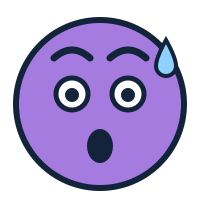 Scared
 Tired
Tired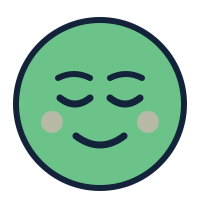 Calm
Calm Excited
 Worried
 Silly
Silly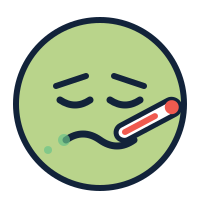 Sick
Sick
What would help?
 A hug
A hug Quiet time
 A drink
 Tell a grown-up
 Play
Play Deep breaths
About this sheet
The faces are the same ones as on the board above, so a child who uses the screen at home and the paper chart at school sees one set of pictures, not two. Each face has an empty circle underneath for a tick, a sticker or a peg. The what would help row is on the same page on purpose: a chart that only asks how you feel gets a feeling and stops there.
To make a peg chart, print it, laminate it and clip a clothes peg with the child's name on it to the edge. For a whole class, print one per child instead and keep them in a folder; that keeps the answers private.
Accessibility notes
- No dragging. One tap on a large target, never a drag.
- No wrong answers. Every tap is accepted and spoken back. Nothing shakes, nothing greys out, nothing is marked wrong.
- Keyboard and switch access. Tab moves between faces, Enter or Space selects, and the focus ring is deliberately thick. A single-switch scanner that sends Tab and Enter can drive the whole check-in.
- Reduced motion. If the device asks for less motion, Maggie's animations switch off and the breathing circle changes size without animating.
- Screen readers. Each step is announced through a live region, and every face has a spoken name.
- Bigger mode increases text and card size for children with low vision or unsteady aim.
- Nothing is recorded. The check-in is not saved anywhere, not even on your own device. Only the settings are remembered.
Questions about the check-in
What is a feelings check-in?
A short, regular moment when a child says how they are feeling, usually by pointing at a face on a chart. It takes about thirty seconds. The point is not to fix the feeling but to notice it and name it, and then to choose something that might help.
What age is it for?
Roughly from three upwards, and there is no upper limit. Start with four feelings for a young child or one who is new to this. Older children and teenagers use the ten-feeling version, and plenty of adults do a version of this every morning too.
Does my child need to be able to talk or read?
No. Every face and every option is spoken aloud, and the child answers by tapping. Written names can be switched off. The board was designed with nonspeaking children in mind, and it sits comfortably alongside AAC.
Is there a right answer?
No. Whatever the child taps is accepted. Maggie never says a feeling is wrong, never asks why, and never tells the child to cheer up. That is deliberate.
Is the printable chart free?
Yes. It is one page, in PDF, and you can print as many copies as you need for home, a classroom or a clinic. No account and no sign-up.
Is anything about my child recorded?
No. The check-in is not saved anywhere, not even in the browser. Only the settings, such as sound on or off, are remembered on your own device.